For todays winter hike, I headed southwest of Spokane to the BLM’s Fishtrap Lake Recreation Area. A hour drive brought me to the trailhead for this hike. I had hiked the north loop a couple of years ago and there is some overlap.
The trail starts out going through what looks like an endless expanse of semi-desert steppe. You can measure the sight line in miles, not feet. Beneath the thin grasses the ground is pretty much basalt rocks. Not much else can grow out here.
After a mile I was able to turn around and see my car in the distance. I imagine some folks give up on this hike after half an hour due to lack of scenery.
On the way to the lake I passed several small iced over ponds. When I hiked this site in the spring of 2022 there was a lot of swampy ground and it was hard to keep my feet dry.
After half an hour you start passing by walls of basalt.
The trail descends through an area of scattered pines and rock outcroppings as you get closer to the lake.
When I made it to the shore near the southwest end of the lake, I wasn’t all that surprised to find it covered in a thick layer of ice. A lot of the ice was black (clear) ice that forms when it’s calm and the lake freezes in a hurry. It is the safest ice to walk on.
Next I followed the western shore to the northeast. I thought this basalt monolith looked a lot like a pill box.
I came across this kolk crater. I had to look up what that is and found out these features are the holes left over from vortex’s caused by gigantic flood events. Apparently they are found throughout the Channeled Scablands.
After detouring around the crater I was back to following the shoreline on rocky bluffs about thirty feet above the ice. Fishtrap Lake is about two miles long but only about one to two hundred feet wide and less than thirty feet deep.
At a gully the trail descended down to lake level and I enjoyed the view to the far shore. I got a good look at the ice and it looked to be over four inches thick. The entire basin reverberated with the distinctive sound of the ice cracking under the immense pressure.
Where the trail deviated inland, it passed beneath another wall of basalt through pines and dense stands of aspen trees. It looked like a wildfire had burned through the area a few years ago. There were a lot of surviving pines which means it wasn’t as hot as some others in the area.
Here I stopped to enjoy the view as it was time to call it good. The lake goes another half mile before it ends at a small resort and is fed from a creek that connects to Hog Lake.
On the way back, I took this photo of a very pretty headland. You can see the shadows are starting to lengthen. This looks like a fun lake to kayak as well.
After finishing a four hour hike, I made a quick detour to the Folsom Farm interpretive site.
On my previous trip to the Fishtrap Lake Recreation Area, I hiked out to the waterfall on the northeast end of Hog Lake. There are lots of places to explore out here. FYI, if you want to see a waterfall don’t wait for summer, the creek will be dry by then.
Fishtrap Lake is just off Interstate 90 about 30 miles west of Spokane. The 9000 acre site has miles of trails, two boat ramps on two lakes, a waterfall and several trailheads. I’ve read mixed reviews on the hiking here, but I highly recommend it, especially for winter and cool early season hiking.
For todays winter hike(s), I visited the Lake Creek Coulee north of Odessa and southwest of Davenport, in other words in the middle of nowhere. The Bureau of Land Management (the real BLM) is responsible for thousands of acres of semi-desert steppe in the area around the coulee including a couple of recreation areas on striking scabland lakes.
To get to this hidden gem I had to drive over two hours west through farmland that looks a lot like Kansas. The areas of central Washington that were not scoured to bedrock by the ice age floods are some of the most productive agricultural lands in the country. Out here you can drive for hours without hardly ever seeing a car or another human.
My first stop was Coffee Pot Lake, a large scabland lake with a small campground and boat ramp just off of the paved road.
From the parking lot I was able to take a short walk over a small headland for a view of the main body of the lake. There were thousands of wild geese all along the shore and in the middle of the open water. I was surprised that most of the lake was ice free. It turned out the lake is deep, eighty feet in some spots and wider than most scabland lakes.
After checking out the day use area, I drove back up the entrance road to a small parking area that accessed the trail above the bluffs on the north side of the lake.
The unmarked trail started out as a double track that looked like it was used for cattle operations. It stayed away from the shear cliffs that bordered the lake at first. Mostly it meandered through sage brush and the tall grass.
A small basalt ridge covered in green lichen paralleled the trail to the north screening the trail from the paved road north of the site.
About half a mile in a short spur brought me to the edge of the cliffs above the lake. It was about two hundred feet straight down from this point. The surface of the lake was covered by thousands of geese all making a thunderous racket with their incessant honking.
To the west down the coulee another lake was separated from Coffee Pot by a low isthmus of dry land. The lower lake is actually seasonally part of Coffee Pot and much sallower.
I continued west off trail along the cliffs using cattle paths and finding openings in the sage brush.
A mile in I came to my turn around point above the isthmus from here I could see the lower lake was indeed frozen as was the far west end of the main lake. I got to watch a coyote hunting below me. He was too far away to get a decent photo of.
On the way back I came across this skull of some unfortunate animal. It is the circle of life.
On the way back I took the spur to the cliff again to soak in the views. Some of these basalt cliffs are beyond vertical. Coffee Pot Lake is listed at over 800 acres making it one of the bigger lakes in the scablands.
Looking back to the west the scene looked like it could have been from the high Artic summer with the dramatic cliffs, patches of ice, little vegetation and thousands of screaming birds.
So after walking maybe three miles along the cliffs, I returned to the parking area and drove a few miles to another BLM recreational site, this time on Twin Lakes.
A long gravel road eventually descended back in to Lake Creek Coulee to a site with a small camp ground, fishing dock and day use parking between two smaller but beautiful lakes.
Time was getting short so I parked and checked out both lakes. Both of them were frozen solid.
A small creek connected the lakes right at the day use area. It was the only open water around.
I checked out the lower lake first. According to topo maps it is very shallow maxing out at about ten feet deep. It was still very pretty. I tossed a couple of small rocks out on the smooth black ice to see how far they would slide.
Some day soon I would like to come back with my kayaks. Both of these lakes looked well worth exploring.
By now I only had a hour or so in my time budget to explore so I crossed a makeshift foot bridge over the connecting creek and followed a trail on the south side of the upper lake. Across the way was a small waterfall that created its own small area of open water. I could hear the sound of the falling water as it hit the lake.
The trail looked like it could have been a little better maintained as it skirted a small ice covered pond.Fortunately it is easy to go off trail in the scablands as long as it’s cold enough to keep the rattlers in their dens.
According to my research the upper lake is quite a bit deeper with a hole around sixty feet deep. At the northeast end of the lake they’re a couple of mature ponderosa pines to break up the grasslands.
Before I called it a day I stopped for one last photo of the upper lake. This is when I saw the first other people in my entire trip. I man and his son set up camp and then set up an ice fishing tent on the ice. They say black ice is the safest to walk on but still sixty feet is a long way down.
I spent more time driving to and from the lakes than i did hiking today. It was still well worth the effort. I had no idea these lakes existed until I researched locations for winter hikes in the Inland Northwest. When I make it back a camping trip and kayaking will be on the agenda. If you want to go shoot for early spring when its still cool and the snakes aren’t active.
For todays hike, I headed an hour or so through and past Spokane to check out the Columbia Plateau Trail, specifically the section from the Amber Lake trailhead towards the north.
Last year I took a short hike on the Columbia Plateau Trail from the end of the pavement outside of Cheney Washington into the Turnbull National Wildlife Refuge. At the time I felt like I didn’t have enough photos or information on this trail to make a post. The unpaved part of the trail started at a trailhead off of Cheney Spangle Road.
The first mile of the trail passes through farm and ranch land before crossing under Cheney Plaza Road and entering the wildlife refuge.
Turnbull Wildlife Refuge is about 23,000 acres and covers a portion of the channeled scablands, a geological area in Eastern Washington created by ice age floods that stripped the soil away and left numerous narrow lakes in coulees. The section I hiked passed by several small lakes and through low cuts blasted through the basalt.
In the area excavated I notice this striking radial design around a small hole. Once you see one of these, you can’t un-see them. These were created by blasting the rocks so the basalt could be more easily removed. Once I saw it, I noticed dozens more through out the cuts.
This line, The Spokane Portland and Seattle was built in 1905 and operated for eighty plus years. The 130 miles between Spokane and Pasco are now owned by the State of Washington and maintained as a public trail.
That was last summer. Today I was looking for a place for a winter hike with limited or no snow and open scenery so I could stay in the sunshine, so I decided to check out another section of this trail.
It took me over a hour to drive to the Amber Lake Trailhead. All of the trailheads require the Discover Pass to use so I used mine. In addition to providing access to the trail there is also a place to launch kayaks or canoes on this pretty little lake.
Like most lakes in the Channeled Scablands, Amber Lake is long and narrow and oriented from the northeast to the southwest in the direction the ancient flood waters presumably flowed. Being late January the lake as to be expected was iced over.
Near the northeast end of the lake, the old railroad bed ran through a cut right next to it.
Soil and rock from the cut was used to create an embankment along part of the lake shore.
Beyond Amber Lake the rail bed curved towards another of these cuts through the basalt. Scattered Ponderosa Pines were the dominate tree species along the trail.
That and birch trees. What looked like frost was actually the last of Decembers snow that had not yet melted in the shade of the rock walls.
Around a bend was a tunnel, kind of. This is a recent addition to avoid crossing one of the only paved roadways in the area, Mullinex Road.
Even in a newer and very remote tunnel, the lowlife vandals have been hard at work degrading the experience for everyone. Thanks scumbags! Even though it wasn’t an original railroad tunnel it was still kind of neat to walk through.
Past the tunnel the cuts through the basalt got a little bigger. You have to be impressed with the work it took to make this railroad a hundred and twenty years ago.
This rock wall shows how the cooling lava created basalt columns. A patch of ice at the bottom is a seepage of ground water.
Between the cuts through the basalt the trail passed by numerous small ponds all frozen.
Beyond the trials crossing with Stirling Road the old railbed ran on top of a small embankment between wetlands. This is were I called it good and turned around.
Once back at the parking lot I took a short walk to get a good look at the part of the lake southwest of the trailhead. I decided to make one more detour before I made the drive home.
Just seven miles or so southeast the Columbia Plateau Trail kind of ends at Williams Lake Road just inside Lincoln County. I’ve always found the correlation between trees and the Spokane County line kind of interesting. Spokane County gets drier the further east you head but has Ponderosa Pines right up to the county line. As soon as you cross into Lincoln or Adams counties there are almost no trees.
South of Lake Williams Road the trail reverts to a rough surface of old railroad ballast and isn’t really suitable for even fat tired bikes. In fact its kind of hard to walk on. Only real adventures explore the eighty mile long section from here to Franklin County. Also I understand that several road crossings and high trestle bridges are closed and their are no practical detours around them.
However just across the road from the trailhead there was this epic piece of early twentieth century engineering. This was the largest railroad embankment I’ve ever came across and I couldn’t resist checking it out.
It was well over a mile across a coulee I couldn’t find the name of on this massive earthen berm. It is difficult to impart the scale of this marvel. Quick math gave me a ball park guess that upwards of half a million cubic yards of rock and dirt were used to create it.
Halfway across I could see the barren terraces were I’m guessing all of this fill came from over a hundred and twenty years ago. I’m guessing this embankment was over seventy feet above the coulee floor and tapered from thirty feet wide at the top to well over a hundred feet wide at the bottom.
Looking up the coulee I could see Down Lake with Mica Peak Washington in the far distance almost forty miles away.
After forty five minutes I made it to the other side of the coulee. Now there was nothing left to do but return to the trailhead. The sun was getting pretty low on the horizon and the scablands are lonely country.
I took a last look at this giant causeway and called it a day. I would call both the section of the trail southeast of Amber Lake and the massive embankment hidden gems in the Inland Northwest. It is an epic landscape indeed.
Exploring old abandoned railroads is one of my favorite things to do. This rail trail eventually crosses over the Palouse Cascade Trail anther thirty miles or so to the southwest. I guess I have more places to check out next spring.
For my first post since my return to the Inland Northwest I headed fifteen minutes down the road to Spokane County’s Saltese Uplands Conservation Area.
I chose this hike because partially due to our mild winter, the site is mostly snow free and is open to the sun. When the wind is still and the sun is out thirty degrees isn’t too bad. Down at the valley floor at two thousand feet we’ve had les snow so far this year than Pensacola or New Orleans. The mountains are another story and I would have to trudge through several feet on the mountains that border Spokane and Coeur d’Alene.
The hike starts at a trailhead on Henry Street between the towns of Liberty Lake and Spokane Valley. As always Spokane County offers free access for day users and maintains an excellent trail system on their properties. This is the first sign I’ve seen telling people not to leave their used dog poop bags on the trail. I see them all the time and am amazed at the mentality that thinks someone else should pick up after them.
They’re about seven miles of trails winding around the six hundred plus acres of native semi arid steep. Not all of the Inland Northwest is covered in farmland or evergreen forests. as I climbed a series of gentle switchbacks up Turtle Gulch, I had a view of the Saltese Flats Restoration Area, another Spokane County conservation site.
Only a few scattered Ponderosa Pines are found mostly in sheltered draws. The rest of the site is covered in grasslands with a few rock outcroppings.
The trail climbs to the sites highpoint next to a water storage tank. It is a leisurely walk. The total elevation gain around five hundred feet.
The Saltese Uplands are known for being a place to view bird life. I saw a couple of hawks, magpies and this little guy who let me take a photo.
Across the wetlands of Saltese Flats are the Dishman Hills with its excellent hiking including the Rocks of Sharon.
After climbing out of the gulch you are treated to nice views of the surrounding mountains. This is the view of Mica Peak Idaho, AKA “Signal Point” and Shasta Butte, “AKA Big Rock” along with smaller Cable Peak on the right side of the photo.
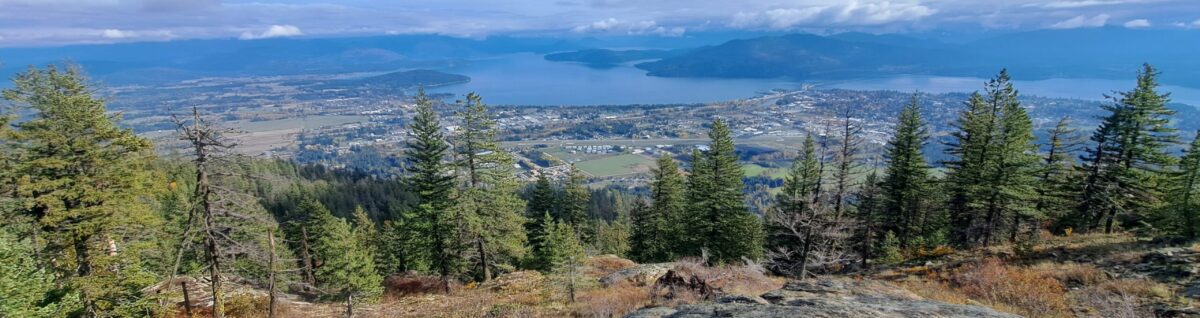
At the top there is a nice view of Liberty Lake with the mountains behind it. I could see ice forming on the lake. The marshland on the far right side of the picture is in Liberty Lake Park, another excellent hiking site owned and managed by Spokane County.
At the top there was a couple of inches of old snow from a few weeks ago. Due to the cold dry air and the effects of evaporation what was left looked like tiny shards of white glass.
Looking towards Idaho and Post Falls from the high point I enjoyed the view of Mt. Rathdrum center left and Chilco Mountain on the far right horizon. It was kind of neat seeing so many of my favorite hiking places. Now I can’t wait for the snow to melt.
I had to walk around the water storage tank on the top to get a view of Mount Spokane across the valley. They are definitely skiing up there.
After the high point, it was an easy three mile walk back to the trailhead. On the way I checked out Mica Peak Washington with its distinctive FAA radar dome. So you might ask why are they’re two Mica Peaks within six miles of each other. Well its because at some point the one in Idaho was renamed on topo maps. Most everyone who grew up here still calls it Signal Point. There is a town of Mica on the west side of Mica Peak Washington too.
Near the end I crossed the gully’s again and walked through this little tree tunnel where a seasonal creek runs in the early spring.
It’s not the most exciting hike in the area but it is different and more importantly a good place to stretch your legs in the winter. I ended up covering about five and a half miles which provided a much needed excuse to get outside this time of the year.
Hopefully I’ll get in a couple of more winter hikes while we are enjoying the break in the weather. I’m looking for low elevation sites that are mostly snow free and they’ll all be west of Spokane in the scablands.
I got a chance to return to the Bug Springs Trailhead off of the General Hitchcock Highway to explore a little further as I ran out of time when I hiked this spot a month ago. I didn’t know what to expect but was pleasantly surprised at how awesome the hike turned out to be.
The first part of the hike was a repeat of my trip before, but the scenery was still just as pretty. Open grasslands with desert plants and rock outcroppings along a well defined ridge made for a great walk.
Once past my turn around point from my last trip here, I soaked in the views towards Bear Canyon and Thimble Peak to the southwest.
As I gained elevation from 5000′ to about 6000′, I enjoyed the commanding views back in to the Tucson Basin behind me.
The first part of the hike passed through an area with a lot of burned over small trees. The area must have been the site of a wildfire a few years back. That’s Tanque Verde Ridge in the distance.
The further I got, the more interesting the rock formations became. I guess you would call these stacks “hoodoos”, tall, thin spire of rock formed by erosion. .
Up a couple of switchbacks and around a corner, I came to this wilderness of rocks. The hike kept getting better and better.
I didn’t ignore the small views either. This striking plant with reddish smooth bark is desert mahogany.
And these are agaves. Agave plants are used in the production of tequila and are found through out the desert southwest as well as in the Caribbean.
After rounding one more bend, I came to an exposed ridge with the most amazing rock formations.
I got to see these hoodoos up close with their typical cap stones and fantastic shapes.
The ridge ended at this pile of rocks and from there the trail descended in to a ravine not too far from where I had turned around when I hiked out of the Lower Green Mountain Trailhead back in November.
I made this my turn around point but stopped to enjoy the views for a half hour of so. From this exposed ridge I could see the Santa Rita Mountains and Mount Wrightson maybe forty miles to the south.
As always, the views on the way back are a little different. I didn’t pay too much attention to this impressive wall of rock on the way in.
This massive hoodoo looked like it belonged on Easter Island.
As high as I got, there’s still three thousand feet of mountain above me. Mount Lemmon an impressive natural feature that dominated the north side of metro Tucson.
This turned out to be one of the best hikes I took during my stay in the Tucson area. The trail was really made for mountain bikers, but supports hiking nicely. You just need to be aware of the possibility of bikes coming down the grade. They are concentrating on the trail and since we can hear and see them first, it would be considerate to step a few paces off of the trail to make things a little easier on them.
My hike turned out to be about six or seven miles long with a thousand feet of elevation gain. Not too strenuous and not to easy, like Goldilocks porridge it was just right.
About an hour south of Tucson are the Santa Rita Mountains, one of Southern Arizona’s Sky Islands. Madera Canyon on the north side of this small mountain range is a popular starting point for some high altitude hiking adventures.
An eleven mile long paved road brings you from Green Valley, an exurb of Tucson, to Madera Canyon in the Santa Rita Mountains unit of Coronado National Forest.
At the entrance to the canyon you can purchase a day pass for $8 or a week pass for $10. Or you can like me use your America the Beautiful Pass. On weekends the entrance is staffed by folks from the Friends of Madera Canyon, a non-profit that helps maintain and improve the area for recreational use.
Most of the Santa Rita Mountains are above five thousand feet in elevation with the highest peak at almost nine and a half thousand feet allowing the area to support a temperate forest surrounded by desert basins.
I began my hike at the Mount Wrightson Trailhead at the end of the road. As soon as I got out of my rig I encountered a raft of wild turkeys.
My plan was to hike a little over six miles with 2100 feet of elevation gain by completing a loop using the Vault Mine Trail, the Aqua Caliente Trail and the Old Baldy Trail. Almost as soon as I started, I ran into a Forest Service Ranger who asked about my plans. He warned me that the Vault Mine Trail was really steep and that it would hurt. He also wanted to make sure I had enough water and some heavier cloths in case it got cold. I appreciated the concern.
He was right. The trail soon climbed steeply out of the dried creek bed on a series of switchbacks. It wasn’t the the hardest hike I’ve done in the last year, but it did get my attention.
As I climbed out of the canyon, I was treated to views of the high points to the east including the summit of Mount Wrightson.
The trail climbed through a forest dominated by hardwood trees with scattered stands of junipers and pines. It looked a lot different than most of Arizona.
A lot of it looked more like something from the East Coast. Except for the topography, I could have pictured this as some scrubby oak forest from Central Florida.
The vegetation was so thick that when I came to openings with views of the nearby peaks, the scene looked almost tropical.
The going was slow but eventually I came across the site of Vault Mine. It looked like they gave up looking for treasure pretty quickly. The tunnel only went in twenty feet or so.
The view looking back out was pretty impressive.
I ended up gaining almost all of the 2100 feet in elevation on the first mile and a half of the hike. I took my time and it took almost two hours to reach this point. The rest of the trip was level or down hill.
Although most of the vegetation on this hike didn’t have thorns, they’re were some exceptions. I was able to grab branches to assist my climb if I was careful and I only got poked in the ankle once by a hostile.
Looking back down the canyon from the junction with the Aqua Caliente Trail, I could see the basin Tucson is in thirty or forty miles to the north. The distant ridges are the Santa Catalina Mountains and Tanque Verde Ridge which is more to the right side of this photo.
The next two miles of the trail followed the north face of a ridge through mostly hardwood forest that had already dropped its leaves. It was actually very chilly up here and even through I didn’t use it, I was glad I brought a light jacket in case it got any worse.
This part of my hike could easily pass for Appalachia during the brief period between the trees shedding their leaves and the snow hitting the ground.
As the trail headed east along the north side of the ridge that divided the Santa Rita Mountains, the big mountains on the east side became much closer.The top of the ridge seemed only a few feet above the trail, but there was no view looking south.
Finally I found an unofficial trail that lead to the top of the ridge. Sure enough in just a hundred feet or so I crested the ridge and had this amazing view looking towards Mexico.
As soon as I crossed over, the temperature was at least fifteen degrees warmer. It would have been comfortable to sunbath in. Back on the northside I had goose bumps on my bare arms.
I continued towards Josephine Saddle and was treated to better and better views of Mount Wrightson. At my highest point on the hike I was still over two thousand feet below the summit.
Looking back towards the northwest I could see one of the large open pit mines near Green Valley. It would have been kind of pretty if you didn’t know just how toxic the waste water from these sites is.
Just before I got to the saddle I caught this image of a high flying jet over the mountain.
At the saddle I took a quick detour down the Josephine Canyon Trail to see if the views to the south opened up. That’s when I saw the Fred Lawrence Whipple Observatory on one of the peaks to the west.
I made it down a few hundred feet and got a couple of fleeting views looking south but turned back to avoid getting sidetracked. I still had a long way to go to get back to the trailhead.
When I got back to Josephine Saddle I came across a memorial sign for a tragic incident from over half a century ago. When I got back I did a little research and would recommend others do so as well. Six Boy Scouts attempted to summit what was called Mount Baldy back then on a clear November day. A freak blizzard struck the area and three of them never made it home.
After the saddle I headed back down towards the trailhead on the Old Baldy Trail. It wasn’t as steep as the Vault Mine Trail but it did lose a couple thousand feet over a little more than two miles.
Not too far down I ran across this little fella. Coatimundi’s are native to Southern Arizona. This was the first one I’ve seen and this was the best shot I could get of him. They’re a little shy.
I enjoyed walking down hill through the hardwood forest. By now I was in for over five hours. I know that’s a long time for a six and a half mile hike, but I took my time, after all what’s the hurry.
Looking back towards the mountains I was treated to a view of a half moon rising above them. Not a bad way to finish up a long hike.
Just before I made it back to the trailhead I passed by this sign that let me know I had been in a wilderness area. That wasn’t really a surprise.
Near the trailhead I was back down in the bed of the dry creek with it’s variety of trees. Also I ran across all those darn turkeys again.
It was one of the most beautiful hikes I’ve been on and I only scratched the surface as far as exploring this gem of a hiking place.
If I get a chance I will go back. There is a trail called the Super Loop that’s a little longer with more elevation gain. If I feel frisky, I’d like to try and make it to Baldy Saddle at 8700 feet.
For the second time during my stay in the Tucson Area, I hiked on the Tanque Verde Ridge Trail. This time I pushed it as far as I could with the goal of making it up to the transition zone from all desert plants to the dwarf juniper forest at five to six thousand feet in elevation. The trailhead is in Saguaro National Park at about three thousand feet.
From the park visitor center there is an open view of Tanque Verde Ridge. In the photo you can see where the ridge top transitions from pure desert habitat to a mixed juniper scrubland. I used my America the Beautiful pass to pay for the admission.
At the trailhead the first couple of hundred yards of the trail is relatively level as it crosses a couple of small washes before it really starts climbing the ridge.
The desert is a harsh environment. Most of the vegetation consists of various species of cacti.
Known sometimes as Jumping Cactus, these Cholla Cactus plants don’t actually “jump”. It’s just if you accidently brush against it the lobes break off easily, hook to you or your clothes and hitch a ride. Not being a moron I haven’t had a problem with them yet.
This is the dried out skeleton of a dead prickly pear cactus. Sometimes it’s nice to appreciate the small views.
The tail soon gets a lot steeper as it climbs up the ridge. I’m guessing I made it about six miles in before I turned around and the grade reminded me a lot of Scotchman Peak in Idaho.
About an hour of steady climbing got me to here. In places the trail crosses bare slabs of rock. The views back toward Tucson became more expansive.
On the way up I set my short term goals to reach the top of the small knolls ahead so I could see what the next view would bring. I was under no illusions about making it to the summit. The trail is fifteen miles one way and the elevation gain is almost four thousand feet.
From the ridge looking south is a view of Mount Lemmon, the highest point in the area at over nine thousand feet above sea level. You can drive up very nice road to close to the summit.
A couple of miles in I went off trail to check a view point and stumbled on this stash of water. I’m not sure of the purpose but assume it had something to do with a trail maintenance crew.
The views towards Tucson are very nice. The light colored patch in the distance at the center top, is the “Boneyard” at Davis Monthan Airforce Base. Downtown is on the far right side of the photo almost at the base of the far mountains about twelve miles away.
As I climbed the ridge I had views back towards the knolls that had been my goals on the hike. The one in the background with it’s bare rock dome, was pretty impressive.
The trail was well made even though it was very steep in places and despite the appearance in this photo, the thorny plant life was fairly easy to avoid if you use common sense.
About three hours in I came to my first juniper tree. This turned out to be a loner. There weren’t anymore for over a half mile.
The habitat was slowly changing with more grasses and less prickly pears in the under story. The stunted desert trees were a little larger this high up the ridge.
So after three and a half hours it was time to call it good. I made it to about 5800 feet and beyond the trail dropped sharply towards the Juniper Basin Camping Area. As you can see I was still in the semi-desert steppe area and didn’t make it to a juniper forest.
On the way down I had more time to enjoy the views. Tanque Verde Ridge is a nice convenient place to hike. You can pretty much hike as far as you want. I made it to my limit and that was fine.
I missed this gem on the way up. The imagination ran wild with ideas of what lived in there and if it watched me on the way up. It’s always a good idea to watch your six when you’re this far out there.
Six hours after I set out, I was back at my rig. I had to share a photo of my Free State America gear.
Tanque Verde Ridge is about a twenty minute drive from my temporary base camp. I may go back again before my time here is done. We’ll see. I’d like to see more wildlife next time.
Today I hiked Bear Canyon in the Pusch Ridge Wilderness Area. Bear Canyon is the twin to Sabino Canyon and is separated from it by a ridge dominated by Thimble Peak. Both hikes begin at the same trailhead off of the north end of Sabino Canyon Road.
A wide trail leads from the visitor center and parking lot through flat desert to the east and the canyon mouth.
On the way to the beginning of the canyon about a mile and a half away, the trail passes through beautiful desert scenery and crosses the wash of Sabino Creek with it’s band of hardwood trees changing color in the late Arizona autumn.
After cresting a small rise, the trail drops down to Bear Canyon Wash. Unlike Sabino Canyon there is not a paved tram road accessing the first four miles of the canyon.
My goal for the day was to push about a mile past Seven Falls and catch a glimpse of a more remote canyon beyond the normal turn around point for about ninety five percent of the hikers.
After the first mile and a half the wide trail is done. The rest of the way is on a rough but well made single track. In the lower elevations saguaro cactus dominate the landscape. Saguaro National Park is only a few miles away.
Quickly I came to a sign that let me know I was entering the wilderness area.
On the way up the canyon the trail crosses the Bear Canyon Creek Wash seven times. The wash supports limited hardwood trees and some grasses giving a break from the cacti dominated habitat on the canyon rim walls.
From the wash looking up you get a feel for the scale of the landscape. Just a half mile of so into the canyon the walls soar maybe a thousand feet above you.
There’s not a lot of places I’d recommend stumbling off of the trail accidently, but this one would be worse than most.
Four and a half miles from the trailhead I got my first view of Seven Falls. Obviously being in the desert there’s water flowing down this cascade maybe a dozen days out of the year. I bypasses the “Falls” and pushed on up towards the rim of the canyon.
Looking back down the canyon I could see parts of Tucson in the distance. The trail followed the canyon through an S turn and soon the mouth of the canyon was hidden from sight making it seem like I entered a truly remote area.
The wash bottom seemed like an oasis compared to the surrounding canyon. In places there were small ponds where the stream bed was solid rock.
I pushed it maybe a mile past Seven Falls and the trail really closed in. The trail itself was well made but a years worth of vegetative encroachment had an effect. It’s not like the plants I brushed against were soft and spongy. Also I was wearing shorts and low cut shoes.
On the way back towards Seven Falls I had this view of the switchbacks that got me this far. In the Pacific Northwest you don’t usually get to see the path you took as there’s enough trees to hide the trails from across whatever canyon you’re on.
I don’t know what these guys are called but they seem particularly formidable.
So I took the spur path to the bottom pool at Seven Falls. As you can see it’s a popular place. The third pool up (very top of the photo) looked even better from above but getting there would have required a real rock scramble. I saw some youngsters do it but sometimes I need to check my ego. I’m not one of them anymore and broken bones don’t heal real quick anymore. That’s assuming I’d survive the fall.
Below the pool the stone was as smooth as silk. The power of erosion by water is amazing.
So I took a few photos of the lower pond trying to work around the other sightseers and headed back to complete my hike.
The walk back down was just as pretty and the lighting a little different as is was several hours later. The clear blue skies did turn overcast but that was alright with me.
The last mile and a half back was through the desert flats. The retaining wall next to the trail apparently was part of a system used to mitigate runoff from flash floods.
Just before making it back to the visitor center I did get a look at some local wildlife.
I think Bear Canyon might be a little prettier than it’s more popular twin, Sabino Canyon. It sure has a lot less people and not having a tram road the first four miles makes it feel much more remote.
I ended up covering between ten and eleven miles over a six and a half hour time frame. The elevation isn’t bad, maybe a close to fifteen hundred feet, but over a hike that long it was not a bad grade. It is possible to do a loop up Bear Canyon and down Sabino Canyon. If I try that I might give in and take the tram as far up as I can to save a few miles. It would be an all day adventure.
I took a drive up the General Hitchcock Highway to the top of Mount Lemmon, a prominent peak just north of Tucson Arizona. Tucson sits at about 2700 feet in elevation. The top of Mount Lemmon is over 8900 feet. On the way up and back I checked out a few hiking options. One of them was a stand out. The others, not so much.
The road to the top is one of the prettiest drives I’ve ever been on. There are numerous scenic turn outs along the seven thousand foot climb over about twenty five miles. This one near the bottom has a view of Thimble Peak, a promontory overlooking Sabino and Bear Canyons.
A few miles in I came to Windy Point. There are really no trails out of this view point but it is extremely photogenic and a short walk on bare slabs of rock brings you to outstanding views of the Tucson basin. Here the desert begins to transform in to a dwarf forest of junipers and pinion pines.
I lingered here for half an hour enjoying the views. This is a popular place with tourist but as it was a week day off season I almost had the place to myself.
Looking up from Windy Point towards the peak of Mount Lemmon revealed a wilderness of rocks. Much of this back country is within the Pusch Ridge Wilderness Area.
The transition from one kind of habitat to another is fascinating. The views are a bonus.
I continued several miles up the mountain to the Palisades Visitor Center and then on to the trailhead for the Aspen Trail. The description sounded nice. There was no signage providing guidance from the trailhead to the trail and after walking through an area of vacation cabins I ended up on a dirt road that doubled back to the main road. At least I got this photo on the way.
Next I drove past the ski area, yes they have a ski area outside Tucson, the snow is mostly manmade, to the Marshall Gulch Trailhead. The trailhead was closed for the season so I had to walk half a mile to it. Once I got there I discovered that the trail was so poorly made that is was difficult to follow and to be honest kind of dangerous as well as not very scenic.
At least I got this picture of a local rodent on the way back to my car.
I headed back down the mountain and stopped at the Bigelow Trail Trailhead. This place had some nice views to the north towards Oracle Arizona but the trails was extremely steep and headed down in both directions. I pushed it a little but turned back soon.
The area this trail went through obviously was the site of a fairly recent wildfire. There were a lot of hazard trees and the trail itself was rough as hell.
My next stop on the way down was at the Upper Green Mountain Trailhead. I had high hopes for this trail as it started out steep but scenic and well made. It followed a ridge up towards a saddle.
By now I was down low enough in elevation to appreciate the transition zone between alpine forest and desert but the trail got worse.
Like ridiculously worse. Some of these “steps” were so tall that I had to climb up a couple of them on my hands and knees. I got to a pretty place and then suddenly the trail started descending again. It became evident that the trail was going to be up and down. I made it maybe half a mile in before I called it good. Turns out these are all mountain bike trails for gonzos.
This rock was my turn around spot. It was a pretty place but the trail dropped down in to the ravine and I wasn’t interested in gaining the same elevation multiple times.
Defeated I headed down the mountain taking a few photos at turnouts on the way. The roadway at least was well worth the drive but I really wanted to stretch my legs a little.
I stopped at one last trailhead this one called the Bug Spring Trailhead. It looked kind of boring at first but the grade although steep was consistent and the trail well made. Down here it was more of a desert with grasses instead of bare dirt.
The trail climbed up a series of switchbacks to a rocky knoll. The place had kind of a East Africa vibe. The hiking was strenuous but not ridiculous.
After half an hour I made it to a ridge top. I sat on the rock on the left side of the knoll and ate my lunch. It was a beautiful spot.
After the first knoll the trail leveled out and came to this second rocky knoll.
I finally found a pleasant hike on Mount Lemmon.
The desert grass made for a nicer background than dirt and rocks. Down in the Tucson basin that’s all there is. The ridge in the far background is Tanque Verde Ridge. I’ve hike there and in the canyon between at Tanque Verde Falls. Spoiler, there’s no water in the canyon or falls most of the time.
The day was getting short so I had to turn back after a couple of miles. I will go back and push it as far as I can in the near future.
By the time I got back to the trailhead the shadows were getting long. Bug Springs was a nice hike. Some of the ones before were obviously made as mountain bike trails and therefore were not suitable for hiking. This trail had a warning at the beginning about heavy mountain bike use but still it was a nice walk.
The drive up the General Hitchcock Highway was amazing. the trails along the way were more of a mixed bag. There are beautiful ridge lines and canyons that would lend themselves to awesome hiking if the trails were there.
I’ll go back to Bug Springs soon. If I can find other decent hiking trails along the road, I’ll try them out.
I had the privilege of returning to Sabino Canyon a year to the day after may first visit to this amazing place. Sabino Canyon is on the north edge of the Tucson urban area at the base of Mount Lemmon. It is the most popular hiking spot in the area.
Sabino Canyon is supported by a elaborate visitor center with parking lots, restrooms, concessionaires, and a shuttle service. A paved road that is shared by hikers and the shuttle trams leads from the visitor center in to the canyon. The shuttle could be nice for families with small kids to explore the canyon but it is spendy.
The first half mile of this hike passes through a flat desert with giant saguaros and all the other species of plants found in this habitat.
It seems counter intuitive to speak so highly of a hike that starts as a paved road but it is a wonderful start to this adventure. You will be passed by an electric tram about once an hour. The steady easy grade walking up in to the canyon allows one to really enjoy the scenery and to “warm up” for the more challenging parts that follow.
Soon enough you leave the flats and are in the canyon. The road follows a substantial wash “dry creek bed” and the seasonally wetter environment supports some actual trees. In places you can leave the road and follow the wash up the canyon.
Saguaro cacti line the trails through out the natural area. Saguaros are the largest cactus found in the United Sates and can grow to over forty feet in height and live for over two hundred years.
The roadway crossed the wash numerous times. These narrow concrete bridges were built by the Works Progress Administration in 1936, the same year my mother was born.
As you walk up the canyon the rock walls tower above you. The narrow strip of trees along the wash provide some fleeting shade. The bare slopes above have none.
At a little over four miles in the paved road comes to an end. There is one last tram stop that some hikers use as the starting point for their hikes in to the wilderness. A series of switchbacks on a single track trail get you high above the canyon floor and here the real adventure starts.
As you get away from the roadway and above the bottom of the canyon you can clearly see the curvy path of the wash highlighted by the trees along its course with the foliage turning yellow in the late Arizona fall.
At the top of the switchbacks you can continue up Sabino Canyon or take the Phoneline Trail high above the valley back towards the visitor center. I opted to continue deeper in to the canyon at least for a mile or so. Soon I came to this bare rock with a commanding view back down the canyon.
Beyond the end of the pavement, the canyon seems much wilder. There is a new view around every bend.
Higher up the canyon I ran in to some real trees in shadier sections. These were nice places to rest and drink some water. They encourage hikers to make sure they bring a lot of water. I did and still finished all of it before the day was done.
I pushed up over a small saddle as the trail was high above the canyon floor. I couldn’t tell if the rock formations ahead had caves in them or if I was just seeing the effects of the shadows on the rocks.
Beyond the saddle I found myself above a large open basin overlooking the wash. Then I heard the sounds of running water and could just see it below. I guess this far up the stream was still running. I enjoyed the view and called it good. I was in about six miles at this point and had almost that far to go to get back.
I retraced my path back to the top of the switchbacks and then continued on the Phone Line Trail above the canyon. Thimble Mountain overlooks the canyon and is a very distinctive feature as seen from above on the General Hitchcock Highway up Lemmon Peak.
This trail is mostly flat and as I walked down the canyon the canyon drops further and further below me. I took a little time to admire the desert vegetation.
Pretty much everything here has thorns. Do not touch is the watch word in the desert.
Looking back to where I came from I could clearly see the switchbacks that brought my up here.
Looking down the canyon I could see part of Tucson in the distance. The Phoneline Trail is about half way between the bottom and the rim of the canyon.
You might be high above the wash but it’s still a long way to the top and the vegetation does not lend it self to bushwhacking.
In fact it seems almost like the Forest Service installs these devices to keep folks on the trail. That is a lot of prickly pears.
In places the vegetation along the trail looks like it belongs in a botonical garden.
Here is the view looking back up the canyon from the Phoneline Trail towards the end of the road and the switchbacks.
And here is the view looking down towards the mouth of the canyon as I was nearing the end of my hike on the Phoneline Trail. A connector trail brings you back to the tram road again on a series of switchbacks.
As I descended back in to the canyon, I enjoyed the views each unique and beautiful.
One last look from up high revealed this striking cloud formation behind one of the rocky pinnacles.
All too soon I was almost back down to the wash and the tram road.
A walked the last mile or so back to the visitor center on the pavement. It is an easy walk and easy on the knees as well. I was out of water anyway.
Sabino Canyon is definitely the prettiest desert hike I’ve been on. There are lots of big views along the trails.
And small views like this bud on a saguaro that may some day grow in to one of those impressive arms.
I ended up hiking between ten and twelve miles over a seven and a half hour period. The elevation gain over all is pretty moderate for a hike of this length.
I plan on exploring the area more during my stay in the area. There is a second canyon, Bear Canyon right next door in the same natural area that doesn’t have a paved road half way up it. Sounds like a cool place to check out.